
Few debates within the project management profession have proven as persistent as the perceived conflict between PRINCE2 and Agile.
For more than two decades, practitioners, trainers, organisations, and commentators have frequently framed project delivery as a choice between two competing philosophies. On one side sits PRINCE2, often characterised as structured, governance-focused, and documentation-heavy. On the other sits Agile, commonly portrayed as adaptive, collaborative, and responsive to change.
This framing has become so widespread that many professionals entering the field assume they must choose between the two. Yet the question itself may be fundamentally flawed.
In practice, PRINCE2 and Agile address different dimensions of project delivery. Rather than representing opposing philosophies, they often provide complementary capabilities that organisations require simultaneously. The real challenge is not deciding whether to use PRINCE2 or Agile, but understanding the problem each approach is attempting to solve and how they can be integrated effectively within a given context.
The Origins of the Debate
The emergence of Agile approaches challenged many of the assumptions underpinning traditional project delivery, particularly within software development and digital transformation initiatives.
Projects operating in uncertain environments often struggled when extensive planning was undertaken upfront and solutions were defined before sufficient learning had occurred. Agile approaches sought to address this challenge through iterative development, frequent feedback, customer collaboration, and the ability to respond to changing requirements.
As Agile gained popularity, some practitioners interpreted its rise as evidence that traditional project management methods were becoming obsolete. This interpretation was further reinforced by poor implementations of governance frameworks that prioritised process compliance over value creation. Consequently, organisations began framing discussions around project delivery in binary terms:
- Governance versus flexibility
- Planning versus adaptation
- Control versus empowerment
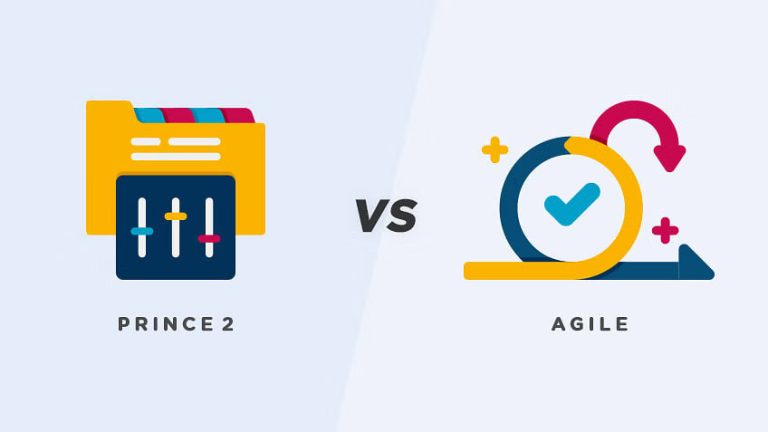
- PRINCE2 versus Agile
While these comparisons may appear compelling, they often oversimplify the realities of modern project environments.
Understanding the Different Purposes of PRINCE2 and Agile
A useful starting point is to recognise that PRINCE2 and Agile were developed to address different concerns.
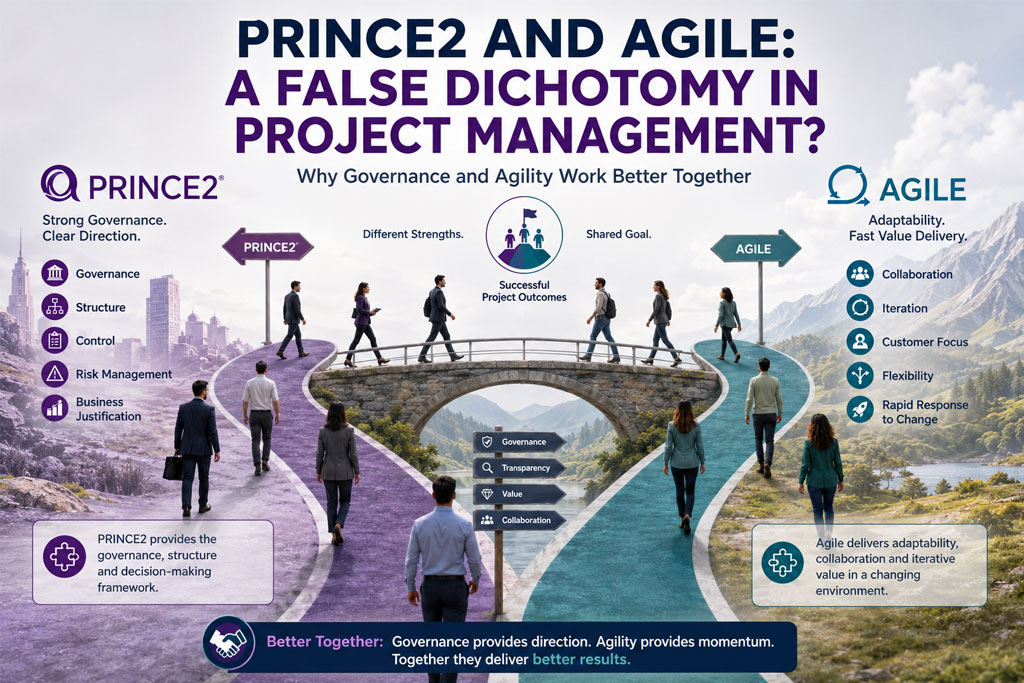
PRINCE2 can be viewed primarily as a project management method concerned with governance and control. It provides guidance on how projects should be initiated, directed, monitored, and closed. Central themes include continued business justification, accountability, risk management, stakeholder engagement, and decision-making.
Agile approaches, by contrast, focus primarily on how solutions are developed when uncertainty exists. Their emphasis lies in learning, experimentation, iterative delivery, customer feedback, and the ability to adapt as understanding evolves. These concerns are related but not identical. An organisation may need to answer questions such as:
- Why are we investing in this initiative?
- Who is accountable for delivery?
- What benefits are expected?
- What level of risk is acceptable?
- Under what circumstances should the project be stopped?
These are governance questions. At the same time, delivery teams may need to answer questions such as:
- What do users actually need?
- How should features be prioritised?
- What have we learned from recent iterations?
- How should changing requirements be managed?
These are delivery questions. Both sets of questions are legitimate. Neither disappears simply because a particular methodology has been adopted.
Governance Remains Relevant in Agile Environments
One of the more persistent misconceptions surrounding Agile adoption is the belief that governance becomes less important as organisations become more adaptive. In reality, the opposite is often true. As uncertainty increases, so does the importance of effective governance.
When requirements are evolving, solutions are emerging, and market conditions are changing rapidly, organisations require clear mechanisms for decision-making, investment oversight, and risk management. Without such mechanisms, adaptability can easily become confusion.
In consulting engagements, I have occasionally encountered organisations that believed they were becoming “more Agile” by reducing governance. In practice, what often emerged was not greater agility but reduced clarity around priorities, accountability, and strategic alignment.
The challenge was not excessive governance. The challenge was ineffective governance. This distinction is important. Good governance should enable delivery rather than constrain it.
The Principle of Continued Business Justification
One of the most enduring contributions of PRINCE2 is its emphasis on continued business justification.
Projects should not continue simply because resources have already been invested. They should continue because the expected benefits remain achievable and worthwhile. This principle arguably becomes more important in uncertain environments.
Agile teams may successfully deliver working outputs through iterative development. However, organisations must still periodically assess whether the initiative remains strategically aligned, financially viable, and capable of delivering the intended outcomes.
The ability to adapt a solution does not eliminate the need to justify the investment. If anything, it increases the need for ongoing evaluation.
The Reality of Hybrid Delivery
The notion that projects must be either PRINCE2-based or Agile-based rarely reflects organisational reality. Most contemporary projects contain elements of both certainty and uncertainty. For example, an organisation may have:
- Fixed budget constraints
- Regulatory obligations
- Governance requirements
- Contractual commitments
At the same time, it may face:
- Evolving customer expectations
- Emerging technologies
- Uncertain solution pathways
- Competitive pressures
Such environments rarely lend themselves to purely predictive or purely adaptive approaches. Instead, organisations often adopt hybrid models that combine governance structures with adaptive delivery techniques. The success of these arrangements depends less on methodological purity and more on the ability to balance control with flexibility.
Beyond Methodology: The Importance of Principles
A recurring theme in both my teaching and consulting work is the distinction between methodologies and principles. Methodologies provide guidance. Principles provide reasoning.
Professionals who focus exclusively on methodology often find themselves engaged in debates about which framework is superior. Professionals who focus on principles tend to ask different questions:
- What problem are we trying to solve?
- What level of uncertainty exists?
- What governance is required?
- How much adaptability is needed?
- What approach best serves the organisation and its stakeholders?
These questions are far more valuable than attempting to determine whether one methodology should replace another.
The most effective project leaders I have encountered are rarely committed to a single framework. Instead, they possess a broad understanding of multiple approaches and the judgement required to apply them appropriately.
What This Means for Project Professionals
For individuals developing their careers, the PRINCE2 versus Agile debate can sometimes create unnecessary confusion. Professionals occasionally feel pressured to identify themselves as belonging to one camp or another. This is rarely helpful.
Modern organisations increasingly require individuals who can navigate both governance and adaptability. They need professionals who understand how strategic objectives are translated into delivery outcomes and how delivery approaches can be adapted without compromising organisational oversight.
Learning PRINCE2 does not make someone less Agile. Adopting Agile does not diminish the value of governance. In many respects, understanding both provides a more complete appreciation of how successful projects operate.
Reframing the Conversation
Perhaps the most useful shift we can make is to move away from asking:
“Should we use PRINCE2 or Agile?”
and instead ask:
“How can governance and adaptability work together to improve project outcomes?”
This reframing acknowledges the complexity of modern project environments and recognises that organisations often require multiple perspectives rather than a single prescribed solution.
The future of project management is unlikely to belong exclusively to any one methodology. Instead, it will belong to professionals capable of understanding context, applying sound principles, and integrating different approaches where appropriate.
Conclusion
The debate between PRINCE2 and Agile has often been presented as a choice between competing philosophies. Yet closer examination reveals that this is largely a false dichotomy.
PRINCE2 provides a framework for governance, accountability, and strategic oversight. Agile approaches provide mechanisms for learning, adaptation, and value-focused delivery in uncertain environments. These capabilities are not mutually exclusive. Indeed, many organisations require both.
Rather than asking which approach is superior, project professionals may benefit more from understanding the strengths, limitations, and intended purpose of each. Doing so moves the conversation beyond methodology debates and towards the more important challenge of delivering successful outcomes in increasingly complex environments.
About Thought Agile
At Thought Agile, we believe that effective project management is not about following frameworks mechanically. It is about understanding the principles that underpin successful delivery and applying them intelligently within the context of a specific organisation, project, or challenge.
Through accredited qualifications, executive education, consulting, and capability development programmes, we help professionals and organisations build the skills, judgement, and confidence required to navigate an increasingly complex world of change.